Amazon Bedrock AgentCore 00: Overview

These are the slides from part 00 of my Amazon Bedrock AgentCore series for the AWS User Group Wellington — a high-level tour of every AgentCore service and how the pieces fit together, before the later decks go deep on each one.
Series: Amazon Bedrock AgentCore deck series
Event: AWS User Group Wellington — November 2026 (#83)
When: Thursday 5 November 2026, 4:30–6:30 PM NZDT
Where: Datacom Wellington, 55 Featherston Street, Pipitea, Wellington 6011
Tip: click into the slides and use the arrow keys to navigate, or hit the fullscreen button for the best experience.
Download the slides: PDF · PowerPoint
Were you at the talk?
Rate it — anonymous, and under a minute.
Open the feedback form — or enter event code 5A36OI at feedbackfeijoa.com.
Every slide is built from the AWS AgentCore Developer Guide and cites the doc pages it is based on.
The big picture
What is Amazon Bedrock AgentCore?
- An agentic platform to build, deploy and operate agents securely at scale
- Works with any framework and any foundation model
- No infrastructure to manage
- Modular: use services together or independently
- Frameworks named: CrewAI, LangGraph, LlamaIndex, Strands Agents
Open-source flexibility and enterprise-grade security — you don't have to choose.
Problems it solves
- Run agents securely at scale — isolated sessions, serverless hosting
- Act across tools and data with the right permissions and governance
- Monitor performance and quality in production
- Remember context across turns and sessions (agents are otherwise stateless)
- Improve continuously with evaluations, recommendations and A/B tests
What can you build?
| Use case | What it looks like |
|---|---|
| Agents | Autonomous apps that reason, use tools, keep context |
| Tools & MCP servers | Turn APIs, Lambda or OpenAPI specs into MCP tools |
| Agent platforms | A paved path: approved tools, shared memory, governed access |
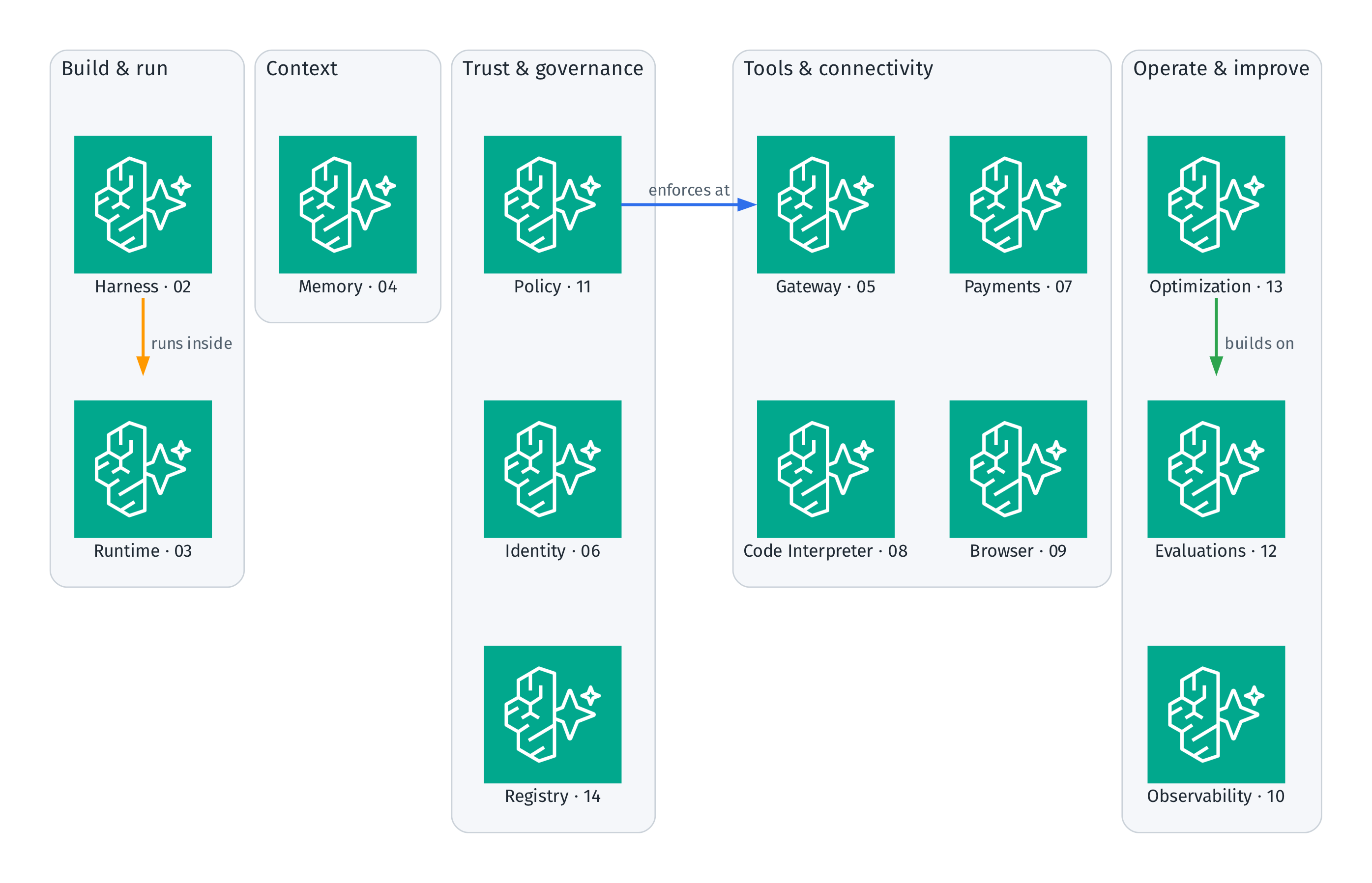
How the services fit together
| Layer | Services |
|---|---|
| Build & run | Harness (managed loop) · Runtime (host your code) |
| Context | Memory (short-term + long-term) |
| Tools & connectivity | Gateway · Code Interpreter · Browser · Payments |
| Trust & governance | Identity · Policy · Registry |
| Operate & improve | Observability · Evaluations · Optimization |
Harness runs inside Runtime; Policy enforces at Gateway; Optimization builds on Evaluations.
Service map
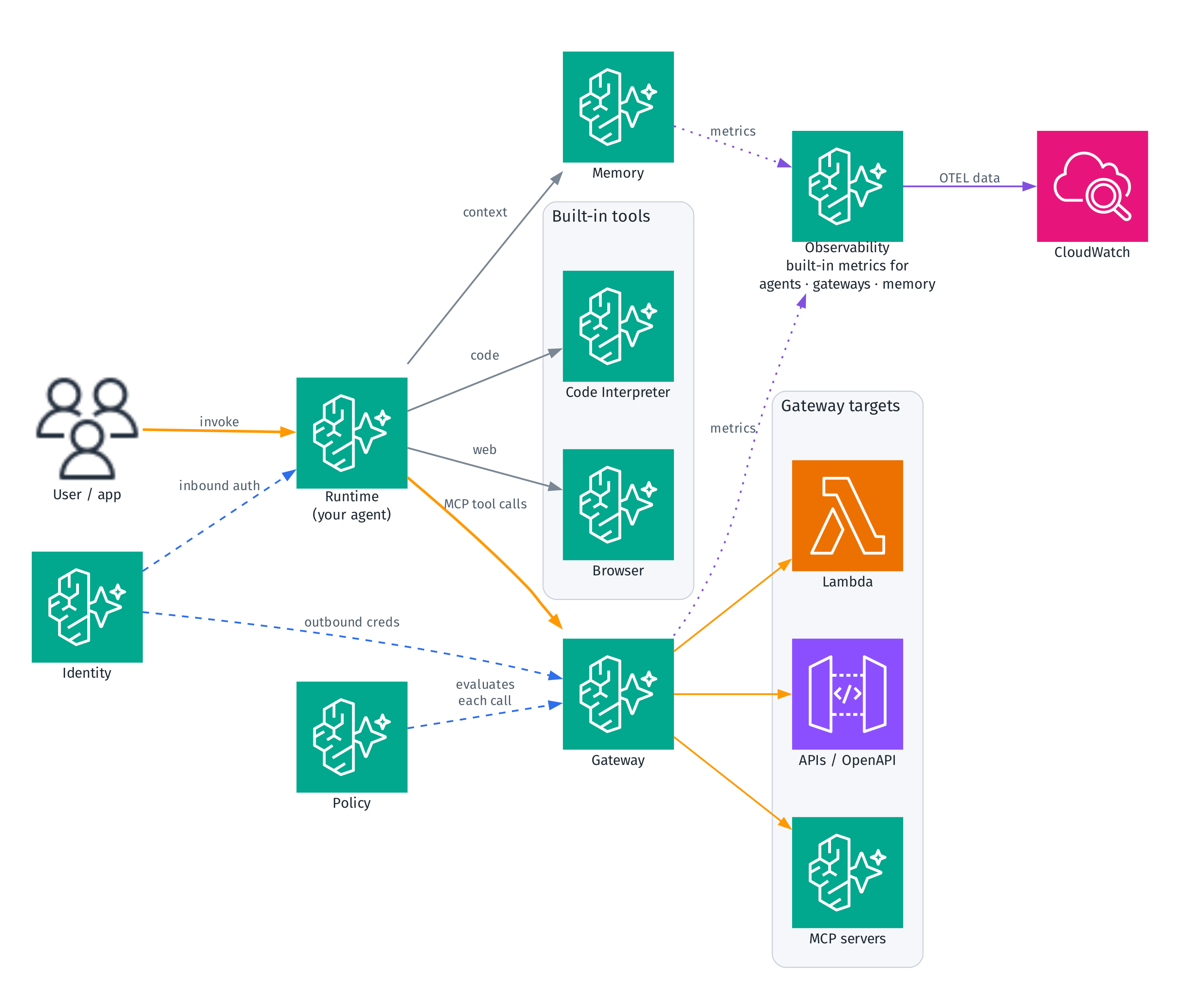
A request, end to end
Build & run
Harness — a managed agent loop
- Declare model, system prompt, tools, skills as configuration; AgentCore runs the loop
- Each session: isolated microVM with its own filesystem and shell
- Models from Amazon Bedrock, OpenAI, Google Gemini, or LiteLLM-compatible providers
- Switch model providers mid-session without losing context
- Tools via AgentCore Gateway, MCP servers, built-in Browser and Code Interpreter
- Powered by Strands Agents; no separate harness charge
Harness — lifecycle and when to graduate
- Built-in short-term and long-term memory; bring your own container
- Mount S3 Files or EFS to share data across sessions
- Immutable versions + named endpoints for safe rollout and rollback
InvokeHarnessstate in AWS Step Functions- Export to Strands code and run on Runtime when config isn't enough
- GA in all regions where AgentCore is supported
Harness vs. Runtime
| Harness | Runtime | |
|---|---|---|
| Orchestration loop | Provided (Strands) | Yours |
| How you add features | Config field | Code (usually AgentCore SDK) |
| Choice of framework | No | Yes |
| Bidirectional streaming | No | Yes |
| Graph / workflow patterns | No | Yes |
| Session isolation, VPC, versioning | Yes | Yes |
Runtime — serverless hosting for agents and tools
- Framework agnostic: LangGraph, Strands, CrewAI or custom code
- Any model: Amazon Bedrock, Anthropic Claude, Google Gemini, OpenAI
- Protocols: MCP and Agent to Agent (A2A)
- Each session in a dedicated microVM; memory sanitized when it ends
- Up to 8 hours per session on microVMs, 14 days on Instances
- 100MB payloads; HTTP plus WebSocket bidirectional streaming
Runtime — key building blocks
- Runtime: hosts your agent or tool code; has a unique identity
- Versions: immutable snapshots; each config update creates a new one
- Endpoints: addressable pointers to a version;
DEFAULTtracks latest - Sessions: identified by
runtimeSessionId, isolated microVM each - Consumption-based pricing: CPU billing aligned to active processing
- Built-in inbound auth via AgentCore Identity (Okta, Entra ID, Cognito)
Context & connectivity
Memory — context-aware agents
| Type | What it holds | Example |
|---|---|---|
| Short-term | Turn-by-turn events in one session | "What about tomorrow?" after a Seattle weather question |
| Long-term | Insights extracted across sessions | Remembering a window-seat preference |
- Long-term records come from strategies added to the memory resource
- Built-in strategies: semantic, user preference, summary, episodic
- Also built-in overrides and self-managed strategies
Gateway — one secure entry point for agentic traffic
- Converts APIs, Lambda functions and services into MCP tools
- Fronts other agents and HTTP services (incl. A2A) via passthrough
- Routes inference across model providers by the requested model
- Inbound and outbound authentication in one managed service
- Semantic tool search across thousands of tools
- 1-click integrations: Salesforce, Slack, Jira, Asana, Zendesk
Gateway — target categories
| Category | Behaviour | Examples |
|---|---|---|
| MCP | Aggregated into one virtual MCP server | Lambda, API Gateway, OpenAPI, Smithy, MCP servers, integrations, connectors |
| HTTP | Direct, no aggregation or translation | AgentCore Runtime agents, A2A agents, passthrough |
| Inference | Model-based routing to providers | Amazon Bedrock, OpenAI, Anthropic |
- Inbound auth: OAuth (JWT), IAM (SigV4), authenticate-only, or none
Identity — identity for agents and workloads
- Agent identities are workload identities in a central directory
- Token vault: stores OAuth tokens, client credentials and API keys, KMS-encrypted
- OAuth 2.0 client credentials (2LO) and authorization code (3LO) flows
- Built-in providers: Google, GitHub, Slack, Salesforce, Atlassian (Jira)
- SDK decorators:
@requires_access_token,@requires_api_key - Native integration with Runtime and Gateway
Payments — microtransactions for agents
- Lets agents pay for APIs, MCP servers and content
- Protocols: x402 and Machine Payments Protocol (MPP), both on HTTP 402
- Wallet providers: Coinbase CDP and Stripe (Privy)
- Per-session budget (
maxSpendAmount, currency) plus an expiry time - Coinbase x402 Bazaar MCP server exposed through AgentCore Gateway
- Launched in Preview (May 2026)
Code Interpreter — sandboxed code execution
- Agents write and run code in an isolated sandbox
- Languages: Python, JavaScript, TypeScript
- Pre-built runtimes with common libraries pre-installed
- Files: up to 100 MB inline; up to 5 GB via S3 with terminal commands
- Default 15-minute execution, extendable up to 8 hours
- Custom session properties and network modes; CloudTrail logging
Browser — a managed cloud browser
- Isolated, containerized browser for agents to use web apps
- AWS managed
aws.browser.v1, or a custom browser (recording, network, IAM role) - Sessions: default 15 minutes, maximum 8 hours; run many at once
- Automation endpoint (WebSocket) — Strands, Nova Act, Playwright
- Live View lets an end user watch and interact in real time
- Session recording to your S3 bucket, replay in the console
Operate & govern
Observability — trace, debug, monitor
- Step-by-step visualisation of the agent's execution path
- CloudWatch dashboards: sessions, latency, duration, tokens, errors
- Telemetry in OpenTelemetry (OTEL)-compatible format
- Built-in metrics for agents, gateways and memory by default
- Instrument your code for extra spans, metrics and logs
- All data stored in Amazon CloudWatch
Policy — deterministic control over tool calls
- Policy engines associated with gateways; every tool call evaluated first
- Enforced at the gateway boundary, outside agent code
- Author in Cedar, natural language, or Dogwood
- Principals:
AgentCore::OAuthUser(JWT) orAgentCore::IamEntity(IAM) - Temporal policies reason over a session's action history
- Decisions logged via CloudWatch for audit
Evaluations — measure agent quality
| Type | When |
|---|---|
| Online | Continuously, sampling live production sessions |
| On-demand | Targeted, on chosen span or trace IDs |
| Batch | Async job over many sessions; aggregate scores |
- Evaluators: built-in (LLM-as-a-judge), third-party (DeepEval, AutoEval), custom
- Custom: your own LLM judge or code-based via Lambda
- Frameworks: Strands, LangGraph with OpenTelemetry / OpenInference
Optimization — the improvement loop
- Recommendations: optimised system prompt or tool descriptions from traces
- Configuration bundles (optional): versioned, immutable config snapshots
- A/B testing: split traffic via Gateway; online evals report significance
- Promote the winner, then repeat from the new baseline
Builds on AgentCore Evaluations — you pick the target evaluator to optimise for.
AWS Agent Registry — discover and govern
- Central catalog: MCP servers, agents, tools, skills, custom resources
- Registries hold records; approval workflow gates discoverability
- Hybrid search: semantic + keyword
- Native MCP endpoint for MCP-compatible clients
- Authorization: IAM or JWT from your corporate IdP
- GA (August 2026) with AWS Organizations auto-detection
Security — shared responsibility
- AWS secures the cloud; you secure what you run in it
- Data at rest encrypted by default (AWS owned KMS keys); TLS 1.2+ in transit
- Gateways can use a customer-managed KMS key
- Resource-based policies for Runtime, Gateway and Memory
- Use
aws:SourceArn/aws:SourceAccountagainst confused deputy - VPC and AWS PrivateLink options
Getting started
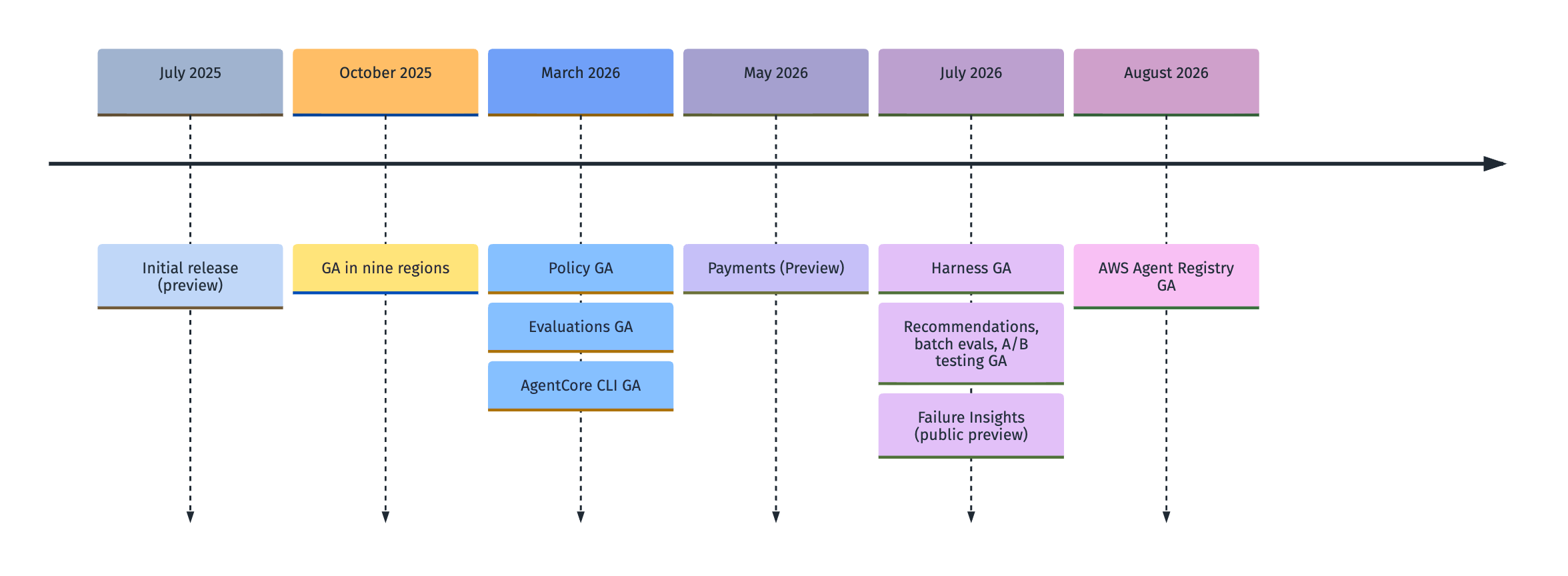
Availability at a glance
| Milestone | When |
|---|---|
| Initial release (preview) | July 2025 |
| AgentCore GA in nine regions | October 2025 |
| Policy, Evaluations, AgentCore CLI GA | March 2026 |
| Payments in Preview | May 2026 |
| Harness, Recommendations, Batch evals, A/B testing GA | July 2026 |
| Failure Insights public preview | July 2026 |
| AWS Agent Registry GA | August 2026 |
Availability timeline
Getting started — the AgentCore CLI
npm install -g @aws/agentcore
agentcore create      # Harness, Agent, or Skip
agentcore dev         # local server + agent inspector
agentcore deploy      # CDK under the hood
agentcore invoke --prompt "Hello, what can you do?"
- Needs Node.js 20+; Python 3.10+ for agent code
- Build types:
CodeZip(default, no Docker) orContainer - Add capabilities:
agentcore add memory | gateway | credential | evaluator
Interfaces for AgentCore
| Interface | Use it for |
|---|---|
| AgentCore CLI | Create, dev, deploy, invoke, status |
| AgentCore Python SDK | Runtime, Memory, Tools, Identity, Evaluations primitives |
| AgentCore MCP server | Transform, deploy, test from Kiro, Cursor, Claude Code, Amazon Q CLI |
| AWS SDK / AWS CLI | Full control plane + data plane APIs |
| AgentCore console | Manage services, agent sandbox testing |
CLI and Python SDK don't cover every operation — fall back to the AWS SDK.
Where to go next
| # | Deck | # | Deck |
|---|---|---|---|
| 01 | Getting Started & Tooling | 09 | Browser |
| 02 | Harness | 10 | Observability |
| 03 | Runtime | 11 | Policy |
| 04 | Memory | 12 | Evaluations |
| 05 | Gateway | 13 | Optimization |
| 06 | Identity | 14 | Agent Registry |
| 07 | Payments | 15 | Security |
| 08 | Code Interpreter |