Reachy Mini x Strands Agent on Jetson Thor - Part 13: Recording Interactions to S3 with Presigned URLs

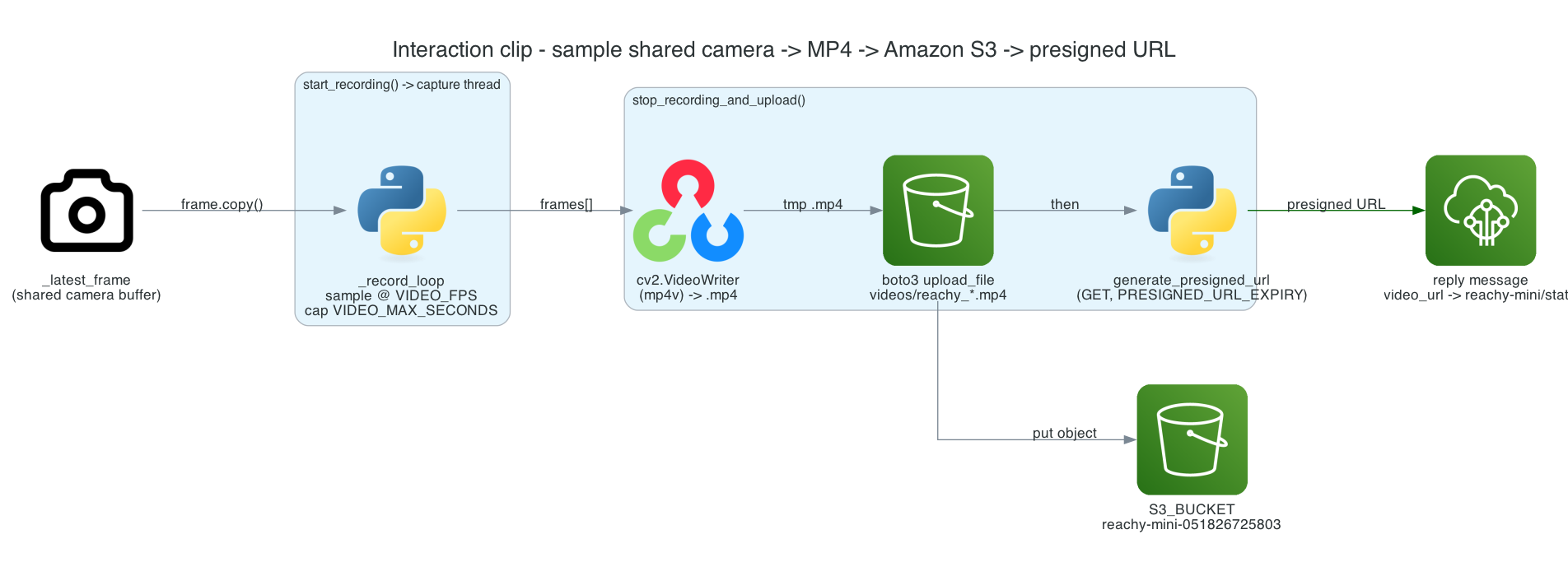
This is Part 13 of the series. The telemetry from Part 12 tells a subscriber what the robot did — but not what it saw. This post adds that: each interaction (and each presence detection) is recorded to a short MP4, uploaded to Amazon S3, and a presigned download URL is attached to the outgoing message, so whoever receives the event can watch the exact clip.
The crucial constraint is the camera. The device is owned by a single streaming loop that keeps _latest_frame fresh for every consumer. Opening a second cv2.VideoCapture to record would collide with that owner — so the recorder never does. It samples the shared buffer instead.
The second principle is that video must be invisible when it fails. The entire encode-and-upload path is wrapped so any error is swallowed and the message simply ships without a video_url — a recording problem can never break or slow an interaction.
Goals
- Record each wake interaction (and each presence detection) to a short MP4
- Sample the shared camera buffer — never open a second capture that would fight the owner
- Upload to Amazon S3 and attach a presigned GET URL to the reply / presence message
- Cap memory with a frame budget, and keep encode dependency-light (
mp4v, noimageio) - Swallow all failures — video must never break an interaction — and no-op when the camera or MQTT is off
The Overall System
For a wake, handle_wake starts a recorder thread before the agent runs and stops-and-uploads after the reply. The recorder samples _latest_frame; on stop, the buffered frames are encoded to an MP4, uploaded to S3, and a presigned URL is attached to the reply message.
System Components:
start_recording/_record_loop— a daemon thread that samples_latest_frameatVIDEO_FPS- Shared camera buffer —
_latest_frame, read under_cam_lock _encode_and_upload—cv2.VideoWriter(mp4v) →boto3upload → presigned URL- Amazon S3 — clips land under
videos/reachy_<timestamp>.mp4 - The reply / presence message — carries the
video_urlwhen present
Interactive Sequence Diagram
Step through a wake interaction — start recording, sample through the interaction, encode, upload, and attach the presigned URL to the reply.
Recording a Wake Interaction to an S3 Clip
The recorder samples the shared frame buffer — it never opens a second capture
Architecture
There are two entry points, both ending in _encode_and_upload:
| Path | Trigger | Capture | Duration |
|---|---|---|---|
start_recording() / stop_recording_and_upload() | wake interaction (handle_wake) | background thread spanning the whole interaction | up to VIDEO_MAX_SECONDS |
record_clip_and_upload() | presence detection (report_human_presence / report_cat_presence) | synchronous, inline | VIDEO_CLIP_SECONDS |
For a wake, handle_wake calls start_recording() before building the agent and stop_recording_and_upload() after the reply is spoken; stop_recording() runs in finally so the capture thread is always torn down. An instantaneous event like presence has no interaction window, so record_clip_and_upload(seconds) records a fixed-length clip synchronously.
How it works
Sampling the shared camera buffer
Opening a second cv2.VideoCapture would collide with the camera owner, so the recorder samples _latest_frame under _cam_lock and copies each frame:
with _cam_lock:
    frame = _latest_frame
if frame is not None:
    _rec_frames.append(frame.copy())
time.sleep(period)
start_recording() spins a daemon thread (_record_loop) that samples at VIDEO_FPS until stop_recording() sets _rec_stop, or until VIDEO_FPS * VIDEO_MAX_SECONDS frames are buffered (a memory cap). It returns False and is a no-op when there's nowhere to send the result — MQTT off (_iot_conn is None) or the camera owner not streaming (_cam_active not set).
Encoding and uploading to Amazon S3
_encode_and_upload(frames) handles both paths. It writes the buffered frames to a temp file with cv2.VideoWriter using the mp4v fourcc (no extra imageio dependency), uploads with boto3, then returns a presigned URL:
writer = cv2.VideoWriter(tmp_path, cv2.VideoWriter_fourcc(*"mp4v"), VIDEO_FPS, (w, h))
for f in frames:
    writer.write(f)
writer.release()
s3 = boto3.client("s3")
key = f"videos/reachy_{stamp}.mp4"
s3.upload_file(tmp_path, S3_BUCKET, key)
url = s3.generate_presigned_url(
    "get_object",
    Params={"Bucket": S3_BUCKET, "Key": key},
    ExpiresIn=PRESIGNED_URL_EXPIRY,
)
Objects land under videos/ keyed by timestamp. The whole body is wrapped in a try/except that swallows any failure (returning None) and a finally that removes the temp file — encoding or upload must never break an interaction. Empty frame lists short-circuit to None.
Presigned download URLs
The presigned GET URL expires after PRESIGNED_URL_EXPIRY seconds and is attached to the outgoing message as video_url, included only when non-None:
publish_state("reply", request=request, reply=reply,
              **({"video_url": video_url} if video_url else {}))
The same pattern attaches video_url to the presence message.
Configuration
| Variable | Default | Purpose |
|---|---|---|
S3_BUCKET | reachy-mini-051826725803 | target bucket for uploaded clips |
VIDEO_FPS | 15 | sample rate from the shared buffer and the MP4 frame rate |
VIDEO_MAX_SECONDS | 120 | memory cap on an interaction recording |
VIDEO_CLIP_SECONDS | 30 | length of a one-shot event clip |
PRESIGNED_URL_EXPIRY | 3600 | presigned URL lifetime in seconds |
Technical Challenges & Solutions
Challenge 1: Recording without a second camera capture
Problem: The camera is a single-opener device already held by the streaming owner. A recorder that opened its own capture would collide and stall both.
Solution: The recorder samples the shared _latest_frame under _cam_lock and copies each frame — it never touches the device. Recording coexists with face tracking and Cosmos vision because all three read the one owner's buffer.
Challenge 2: Video failures breaking interactions
Problem: Encoding or an S3 upload can fail (disk, network, credentials). If that propagated, a recording problem would break the actual interaction.
Solution: The whole encode-and-upload path is wrapped in try/except that returns None on any failure, with a finally that cleans up the temp file. The reply just ships without a video_url — video is strictly best-effort.
Challenge 3: Unbounded memory on a long interaction
Problem: Buffering frames for an open-ended interaction could grow without limit.
Solution: The recorder caps the buffer at VIDEO_FPS * VIDEO_MAX_SECONDS frames and samples at a modest VIDEO_FPS (default 15), bounding memory while still capturing the interaction.
Challenge 4: Two very different capture windows
Problem: A wake has a natural start/stop window; a presence detection is instantaneous with no window to wrap.
Solution: Two entry points share one encoder — a background thread spans the wake (start_recording / stop_recording_and_upload), while record_clip_and_upload(seconds) grabs a fixed-length clip synchronously for instantaneous events.
Getting Started
GitHub Repository: https://github.com/chiwaichan/chiwaichan-reachy-mini-strands-agent-jetson-thor
Enable clips
With the camera owner up and MQTT configured, set the bucket and run:
export S3_BUCKET=your-clip-bucket
./reachy_assistant.sh
Each wake reply and presence event that arrives on the MQTT topics now carries a video_url — a presigned link to the clip the robot recorded. When the camera or MQTT is off, both paths are no-ops and messages simply ship without a video_url.
What's Next
In Part 14 - The Camera/Mic Media Bus, I generalise the single-owner idea into a media bus: one broker owns each single-opener device and fans the live stream out over Unix sockets, so any number of processes — including new ones you add — can read the same camera and mic at once.
Summary
This post covered interaction clip recording to S3:
- Sample, don't re-open — the recorder copies the shared
_latest_frameunder_cam_lock, so it never collides with the camera owner - Encode + upload —
cv2.VideoWriter(mp4v, noimageio) →boto3upload tovideos/reachy_<ts>.mp4→ presigned GET URL - Best-effort by design — the path swallows all failures (returns
None) and is a no-op when the camera or MQTT is off, so video never breaks an interaction - Two paths, one encoder — a background thread spans a wake;
record_clip_and_uploadgrabs a fixed clip for instantaneous presence events - Attached to the event — the
video_urlrides on thereply/presencemessage, included only when present, expiring afterPRESIGNED_URL_EXPIRY