Reachy Mini x Strands Agent on Jetson Thor - Part 10: Real-Time Face Tracking with a Single Camera Owner

This is Part 10 of the series. The robot can already look on demand with Cosmos vision and notice who's around while idle. Now I want it to feel present: its head should follow your face in real time — and it has to do that while Cosmos vision and the idle watcher are also using the camera.
Tracking itself is simple and entirely local — an OpenCV Haar cascade finds the nearest face, and a proportional controller nudges the head to centre it, offline and $0. The hard part isn't the tracking; it's the camera. /dev/video0 is a single-opener V4L2 device, so the face tracker, the idle watcher, the clip recorder, and the Cosmos look path can't each open their own capture.
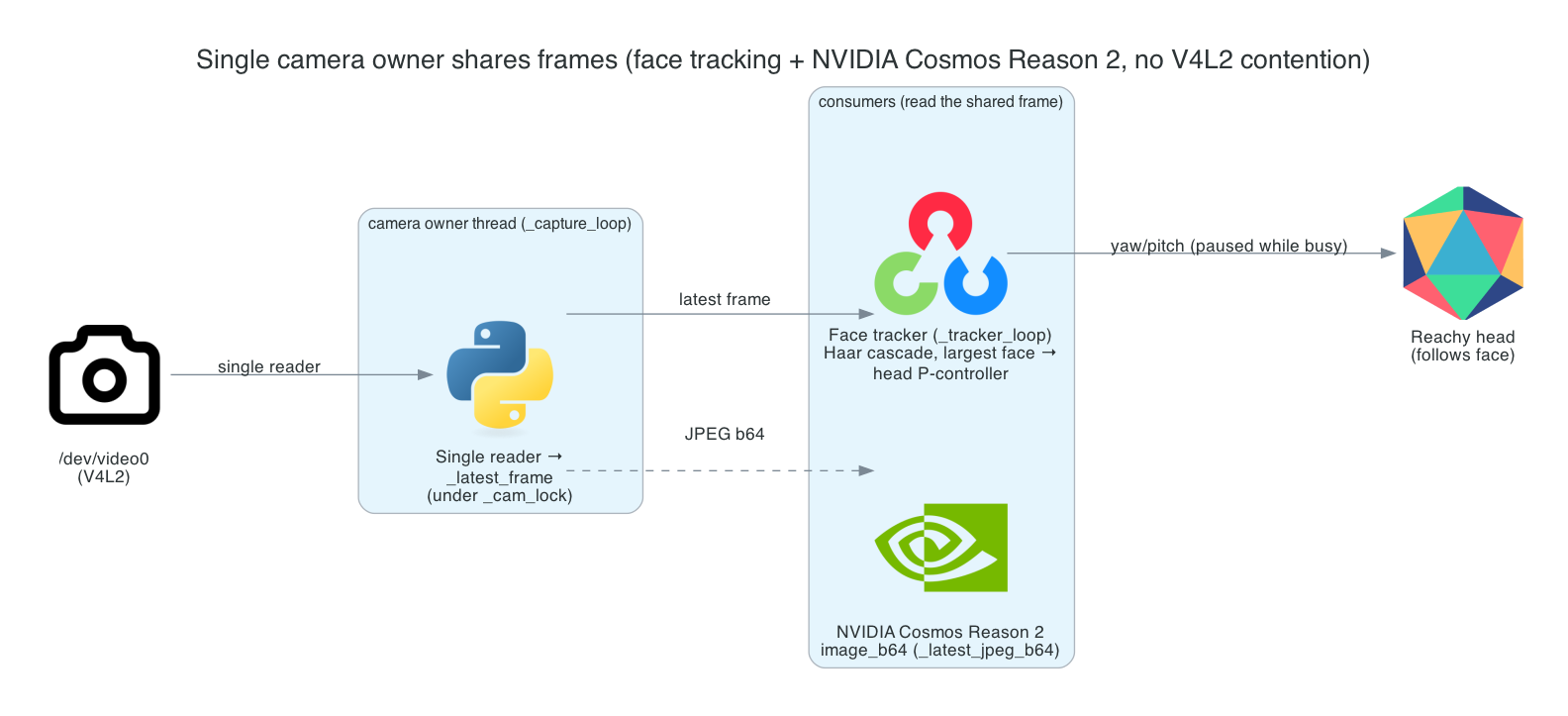
The answer is a single camera-owner thread: one reader of the device that publishes the latest frame to a shared buffer, and every other consumer reads that. Head tracking and Cosmos vision run off the same frames at the same time, with no contention.
Goals
- Make the head follow the nearest face in real time with local OpenCV — offline, $0
- Run a single camera-owner thread as the only reader of the device, publishing frames to a shared buffer
- Let the tracker, idle watcher, and Cosmos vision all read the same frame — no V4L2 contention
- Drive the head with a proportional controller with a deadband (anti-jitter) and mechanical clamps
- Yield the head to a real task: pause and recenter while the robot is busy
- Make tracking tunable and easy to disable via
FACE_*env vars
The Overall System
One thread owns the camera and keeps a shared frame fresh. The tracker reads it, finds the largest face, computes a centring error, and steps the head. The same buffer feeds Cosmos when the agent calls look_and_describe, so vision never opens a second capture.
System Components:
_capture_loop(camera-ownerthread) — the only device reader; keeps_latest_framefresh under_cam_lock- Shared frame buffer —
_latest_frame(BGR) and_latest_jpeg_b64()for consumers _tracker_loop(face-trackerthread) — Haar detection + proportional control of the head- Reachy head — driven via
goto_targetat ~10 Hz - Cosmos look path — reads the same shared frame as
image_b64, never the device
Interactive Sequence Diagram
Step through one ~10 Hz tracking cycle — capture, detect, control, move — and see Cosmos share the same frame on a look.
One Tracking Cycle: Frame to Head Move at ~10 Hz
A single camera owner feeds the tracker and Cosmos from the same frame
Architecture
| Thread | Role |
|---|---|
_capture_loop (camera-owner) | Sole reader of /dev/video0 (or the media-bus broker); publishes _latest_frame |
_tracker_loop (face-tracker) | Haar detection, error computation, proportional head control |
_capture_loop starts whenever FACE_TRACK is on or the camera broker is active; _tracker_loop starts when FACE_TRACK is on. Every in-process consumer reads the shared buffer rather than opening its own cv2.VideoCapture.
How it works
One camera owner, many readers
_capture_loop() runs as the camera-owner daemon thread and keeps _latest_frame (a BGR numpy array) fresh under _cam_lock. When the media-bus camera broker is up it subscribes to that; otherwise it opens /dev/video<CAMERA> directly with V4L2 and MJPG at 1920x1080. Once streaming, it sets the _cam_active event. Every other in-process consumer reads that shared buffer — so the face tracker and the Cosmos look path run off the same frames at the same time, with no V4L2 contention.
Detecting the largest face
_tracker_loop() waits up to ten seconds for _cam_active, then loads the Haar cascade haarcascade_frontalface_default.xml. Each cycle it copies _latest_frame under _cam_lock, resizes to 320x240, converts to gray, and runs detectMultiScale(gray, 1.1, 4, minSize=(30, 30)). It picks the largest face by area as the nearest, and normalises its offset from the frame centre to an error in [-1, 1]:
x, y, w, h = max(faces, key=lambda f: f[2] * f[3])   # largest = nearest face
ex = ((x + w / 2) - 160) / 160.0                      # horizontal error [-1, 1]
ey = ((y + h / 2) - 120) / 120.0                      # vertical error   [-1, 1]
Proportional controller with deadband and clamps
The errors drive the head. Errors smaller than FACE_DEADBAND are ignored to suppress jitter; otherwise each axis steps by gain × error × sign and clamps to the head's mechanical limits (FACE_YAW_MAX 55°, FACE_PITCH_MAX 22°):
if abs(ex) > FACE_DEADBAND:
    tyaw = _clamp(tyaw + FACE_KP_YAW * ex * FACE_YAW_SIGN, -FACE_YAW_MAX, FACE_YAW_MAX)
if abs(ey) > FACE_DEADBAND:
    tpitch = _clamp(tpitch + FACE_KP_PITCH * ey * FACE_PITCH_SIGN, -FACE_PITCH_MAX, FACE_PITCH_MAX)
When either axis moved, the loop calls mini.goto_target(create_head_pose(yaw=tyaw, pitch=tpitch, degrees=True), duration=FACE_MOVE_DUR) and sleeps FACE_MOVE_PERIOD (0.1 s, ~10 Hz) per cycle.
Pausing and recentering while a task owns the head
The tracker yields the head whenever a task is running. At the top of each cycle it checks the _busy event; if a task owns the head it resets the target to tyaw = tpitch = 0.0 and skips the rest, so tracking resumes from centre once the task finishes. The Cosmos look path stays available throughout because it only reads the shared frame, never the motors.
The FACE_* knobs
| Env var | Default | Effect |
|---|---|---|
FACE_TRACK | 1 | Enable face tracking (0 disables; Cosmos server self-captures) |
FACE_KP_YAW | 20 | Yaw gain, degrees per step per unit error |
FACE_KP_PITCH | 16 | Pitch gain, degrees per step per unit error |
FACE_DEADBAND | 0.06 | Ignore errors smaller than this (anti-jitter) |
FACE_MOVE_PERIOD | 0.1 | Head-update period in seconds (~10 Hz) |
FACE_MOVE_DUR | 0.12 | Smoothing duration per head move |
FACE_YAW_SIGN / FACE_PITCH_SIGN | -1 / 1 | Flip if the head moves the wrong way |
FACE_YAW_MAX (55) and FACE_PITCH_MAX (22) are fixed in code as the clamp limits.
Technical Challenges & Solutions
Challenge 1: A single-opener camera, many consumers
Problem: /dev/video0 is a single-opener V4L2 device. The face tracker, idle watcher, clip recorder, and Cosmos look path all need frames — but only one process can hold the device.
Solution: A single camera-owner thread is the only reader; it publishes _latest_frame to a lock-guarded shared buffer (and _latest_jpeg_b64() for the VLM). Every consumer reads the buffer, so head tracking and vision coexist with zero contention.
Challenge 2: Jittery, twitchy head motion
Problem: A raw proportional controller chases every tiny detection wobble, producing constant micro-movements that look nervous.
Solution: A deadband (FACE_DEADBAND) ignores small errors, the per-move smoothing duration (FACE_MOVE_DUR) eases each step, and the ~10 Hz update period keeps motion controlled. Gains and signs are env-tunable so the response can be dialled in per robot.
Challenge 3: Tracking fighting a real task for the head
Problem: If the tracker kept driving the head while a wake task tried to nod or look around, the two would fight over the motors.
Solution: The tracker checks the shared _busy event each cycle and, while a task owns the head, resets its target to centre and skips. It resumes from neutral once the task ends — and Cosmos vision is unaffected throughout because it only reads frames.
Getting Started
GitHub Repository: https://github.com/chiwaichan/chiwaichan-reachy-mini-strands-agent-jetson-thor
Run it (and tune the tracking)
./reachy_assistant.sh                  # face tracking on by default
FACE_TRACK=0 ./reachy_assistant.sh     # disable; Cosmos server self-captures
FACE_YAW_SIGN=1 ./reachy_assistant.sh  # flip if the head turns the wrong way
Stand in front of the robot and move side to side — the head follows. Say "Hey Reachy" and the head recenters for the task, then resumes tracking afterward.
What's Next
In Part 11 - Going Fully Local with Nemotron via Ollama, I swap the agent's brain from Amazon Bedrock to a local Nemotron model served by Ollama on the Thor GPU — so the whole assistant, brain included, runs on-device at $0.
Summary
This post covered real-time face tracking and the single-camera-owner design:
- Head follows the nearest face — an OpenCV Haar cascade picks the largest face and a proportional controller centres it, locally and
$0 - One camera owner, many readers — a single
camera-ownerthread is the sole device reader; the tracker, idle watcher, and Cosmos all read the shared_latest_frame, so there's no V4L2 contention - Smooth control — a deadband suppresses jitter, gains/signs are env-tunable, and the head is clamped to its mechanical limits (yaw 55°, pitch 22°) at ~10 Hz
- Yields to tasks — the tracker recenters and pauses while
_busyis set, then resumes, while Cosmos vision keeps working off the shared frame - Frame sharing —
look_and_describepasses the owner's latest frame asimage_b64, so vision never opens a second capture