Reachy Mini x Strands Agent on Jetson Thor - Part 9: Idle Presence — Noticing Who's Around (Humans vs Cats)

This is Part 9 of the series. So far the robot only acts when triggered — a wake word or an MQTT message. Now I want it to show a little life between interactions: while resting, it should quietly notice who's in the room and have a place to hang future reactions — greet a person, perk up at a cat.
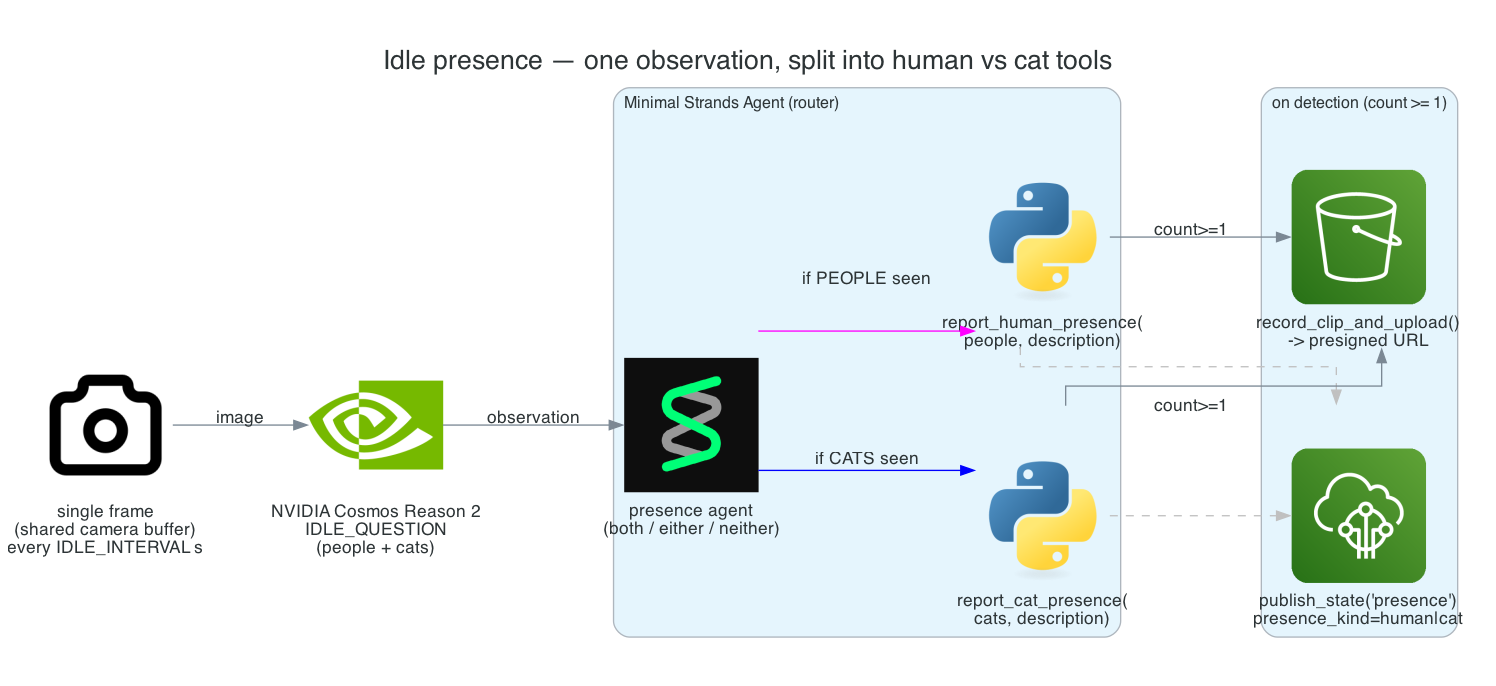
Every IDLE_INTERVAL seconds the robot grabs a frame, asks NVIDIA Cosmos Reason 2 who it sees, and routes the observation through a tiny Strands Agent. The whole thing is fully local — local Cosmos vision, local Nemotron routing — so each glance costs $0, in keeping with the idle-is-free principle that runs through the build.
The design choice worth highlighting is the species split. Instead of one generic report_presence, the observation routes to two tools — report_human_presence and report_cat_presence — so people and cats can drive different behaviours. A single glance can fire both (a person and a cat in frame), either alone, or neither.
Goals
- Have the robot periodically notice who's around while idle, fully local and $0
- Use Cosmos Reason 2 to count people and cats and note what each is doing
- Route the observation through a minimal, disposable Strands Agent to species-specific tools
- Support both / either / neither firing per glance — humans and cats are independent
- Never compete with a real task — skip ticks while the robot is busy
- On a real detection, record a clip (S3) and publish a
presencestate (IoT Core) for downstream systems
The Overall System
A daemon thread ticks on a fixed cadence. Each tick samples the shared camera frame, asks Cosmos a counts-per-species question, and hands the answer to a throwaway agent that routes to the human and/or cat tool — which, on a real detection, record a clip and publish a presence event.
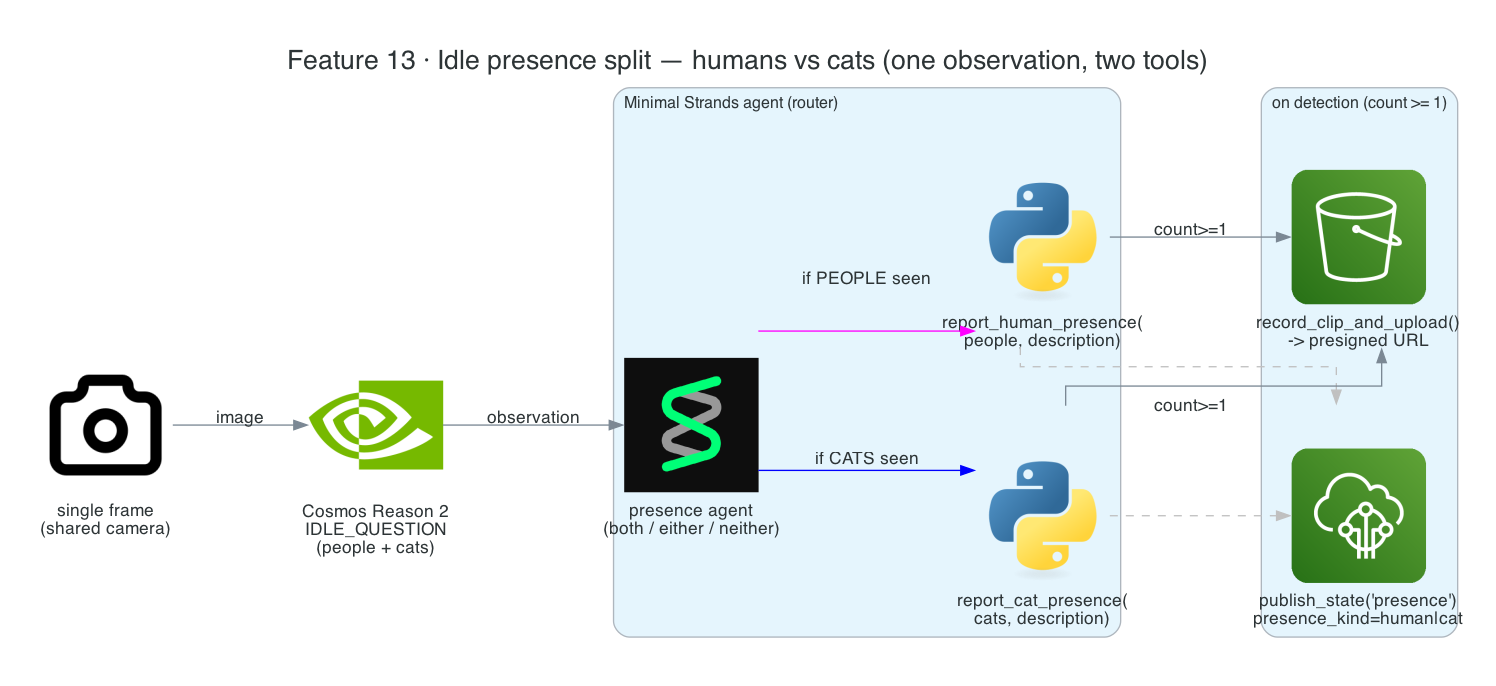
System Components:
_idle_watcher— the daemon-thread loop on anIDLE_INTERVALcadence- Shared camera buffer —
_latest_jpeg_b64(), the same frame the face tracker maintains - Cosmos Reason 2 — answers the counts-per-species
IDLE_QUESTION, locally _run_presence_agent— a minimal Strands Agent built per observation and discardedreport_human_presence/report_cat_presence— the two species tools, each logging and (on a detection) recording + publishing
Interactive Sequence Diagram
Step through one tick where a person and a cat are in frame — observation, species routing, both tools firing, and the clip/state upload.
One Idle Glance, Routed by Species
A minimal agent sends the observation to human and/or cat tools — both, either, or neither
Architecture
| Tool | Args | presence_kind | Log colour |
|---|---|---|---|
report_human_presence | people, description | human | magenta |
report_cat_presence | cats, description | cat | cyan |
Both are @tool-decorated. Each logs a colour-coded line, and only when its count is >= 1 does it record a short clip (record_clip_and_upload() → S3, presigned URL) and publish a presence state message over IoT Core. The presence agent itself is built and discarded per observation, so nothing persists between ticks.
How it works
The idle watcher
_idle_watcher() runs on a daemon thread started at boot. While the robot is resting it loops on a fixed cadence: every IDLE_INTERVAL seconds (default 10) it grabs the latest frame from the shared camera buffer with _latest_jpeg_b64(), sends it plus IDLE_QUESTION to Cosmos Reason 2, prints the observation, and hands it to a Strands Agent. It is fully local, so each tick costs $0. The default IDLE_QUESTION asks for counts and a short note per species:
How many people and how many cats can you see? Give the count of each (0 if none)
and a short note on what each is doing.
Skipping ticks while a task runs
The watcher checks the shared _busy event at the top of every tick. If a real task is running it logs idle watcher: skip tick (busy with a task) and waits for the next interval, so the presence check never competes with a live look or drives the GPU mid-task:
while True:
    time.sleep(IDLE_INTERVAL)
    if _busy.is_set():
        vlog("idle watcher: skip tick (busy with a task)")
        continue
    ans = _look_via_server(IDLE_QUESTION, image=True, image_b64=_latest_jpeg_b64())
    ...
    _run_presence_agent(ans)
Routing one observation to two tools
_run_presence_agent(observation) builds a minimal Strands Agent for that single observation, registers both presence tools, and discards the agent afterward (del + gc.collect()). Its system prompt routes by species:
- one or more people present → call
report_human_presence - one or more cats present → call
report_cat_presence - both present → call both tools
- neither present → do nothing, emit no prose
The species-specific tools
Each tool logs a line, and only on a real detection does it record and publish — so a fully local run (no S3/MQTT) just logs:
if people >= 1:  # only upload when something is actually detected
    video_url = record_clip_and_upload()
    publish_state("presence", presence_kind="human", presence_count=people,
                  presence_description=description,
                  **({"video_url": video_url} if video_url else {}))
report_cat_presence is identical with presence_kind="cat". Both the clip upload and the state publish are no-ops when S3/MQTT (or the camera owner) are unavailable.
Configuration
| Env var | Default | Purpose |
|---|---|---|
IDLE_WATCH | 1 | Set to 0/false/no/off to disable the watcher |
IDLE_INTERVAL | 10 | Seconds between presence checks |
IDLE_QUESTION | counts-per-species prompt | Question sent to Cosmos Reason 2 |
Technical Challenges & Solutions
Challenge 1: Idle awareness that stays free
Problem: Continuously running vision to watch the room could peg the GPU and, on a cloud VLM, cost money around the clock.
Solution: The watcher ticks on a slow cadence (default every 10s), reuses the already-captured shared frame, and runs local Cosmos + Nemotron — so each glance is $0 and the GPU is touched only briefly, on a timer.
Challenge 2: Presence checks colliding with real tasks
Problem: If a user wakes the robot or an MQTT look arrives mid-tick, two vision workloads would contend for the GPU and camera.
Solution: Every tick first checks the shared _busy event and skips if a task is running. The idle watcher always yields to a real interaction.
Challenge 3: Humans and cats need different reactions
Problem: A single generic report_presence can't let a person and a cat trigger distinct behaviours, and both can be present at once.
Solution: Split into report_human_presence and report_cat_presence, each independently fired by the routing agent. One glance can call both, either, or neither — giving a clean hook for per-species behaviour later, while today each records a clip and publishes a tagged presence event only when its count is real.
Getting Started
GitHub Repository: https://github.com/chiwaichan/chiwaichan-reachy-mini-strands-agent-jetson-thor
Run it (and tune the cadence)
./reachy_assistant.sh                 # watcher on by default, every 10s
IDLE_INTERVAL=30 ./reachy_assistant.sh # slower cadence
IDLE_WATCH=0 ./reachy_assistant.sh     # disable the watcher entirely
While the robot rests, watch the log: it prints what Cosmos sees each tick and which presence tools fire.
What's Next
In Part 10 - Face Tracking with a Single Camera Owner, the head starts following your face in real time — and I dig into the single camera-owner thread that lets head tracking, the idle watcher, and Cosmos vision all share one camera without V4L2 contention.
Summary
This post covered idle presence awareness:
- Idle glances, fully local — every
IDLE_INTERVALseconds the robot asks Cosmos who it sees, at$0per tick - Yields to real work — ticks are skipped while
_busyis set, so presence never competes with a live task or the GPU - Species split —
report_human_presenceandreport_cat_presenceroute independently; both, either, or neither can fire per glance - Disposable router —
_run_presence_agentbuilds a minimal agent per observation anddels it, so nothing persists between ticks - Real detections only — clips (S3) and
presencestate (IoT Core) are recorded only when a count is>= 1, and no-op when the cloud paths are off